
Searching Terrell County Criminal Dockets
Georgia's statewide entry point is the Georgia Courts E-Access directory. It sends Terrell County Superior Court searches to PeachCourt. An account is required there. Felony cases are the place to begin. When a record or image never comes up online, the Clerk of Superior Court still keeps the file and can produce it. Before you ask, gather the full name, the court, the filing year, and the docket number if you have it. The local clerk also wants a date of birth, the charge, and the exact document sought, and a number like 25-CR-0000 separates people who share a name.
- Open E-Access and follow the Terrell Superior provider link.
- Sign in to PeachCourt and select Terrell and Superior Court.
- Search by criminal case number or party name.
- Check the court and year, then read events in date order.
- Ask the Clerk for a paper, emailed, or certified copy if needed.
Terrell Criminal Request Identifiers
A name alone rarely works. The Terrell criminal request instructions show what to send instead: the defendant's name and birth date, the docket number if known, the charge, and the precise item you want. Say whether you need an ordinary copy or a certified one.
Fastest route: send the docket number and document title. If either is unknown, add the filing year, full name, and charge.
Copies are not free. Staff-made paper copies run $1 per page plus postage. Email or fax delivery costs $2.50 plus $0.50 per page. Certification adds $2.50 for each complete document, and the Clerk quotes the full price before releasing anything.
Inside a Terrell County Criminal Docket
Think of a criminal docket as a timeline in list form. On PeachCourt, an entry may carry the assigned judge, the case status, co-defendants, counsel, charges, disposition, proceedings, and any filed documents. One catch matters here. Terrell appears as an e-filed-documents-only court, so an event can sit in the docket with no image attached to view.
| Case number | The court identifier, often with a criminal marker such as 25-CR-0000. |
|---|---|
| Charge | The alleged offense and count, not the final result. |
| Setting | Arraignment, pretrial, plea, trial, or sentencing date. |
| Proceeding | A motion, filing, hearing, order, or other dated event. |
| Disposition | The recorded outcome, such as conviction, dismissal, or dead docket. |
The sample PeachCourt criminal frame displays the field layout without exposing any private person's case facts.

That layout explains a habit worth building: read the event list and the document layer as two separate things.
A Charge Is Not Disposition
A filed charge is an accusation, nothing more. Guilt is never established by the filing itself. Read forward in the docket to the plea, a signed order, a verdict, a dismissal, or the sentencing entry to learn what actually happened. Keep in mind that old charges can stay on the docket even after a later event changes their effect.
- Disposition
- The recorded outcome of a charge or case.
- Dead docket
- A Georgia status that pauses prosecution without a final acquittal.
- Nolle prosequi
- A prosecutor’s formal choice not to proceed at that time.
- Reset
- A setting moved to another date, not an ended case.
The local criminal docket information lists record categories and sends calendar questions to the judge's office.
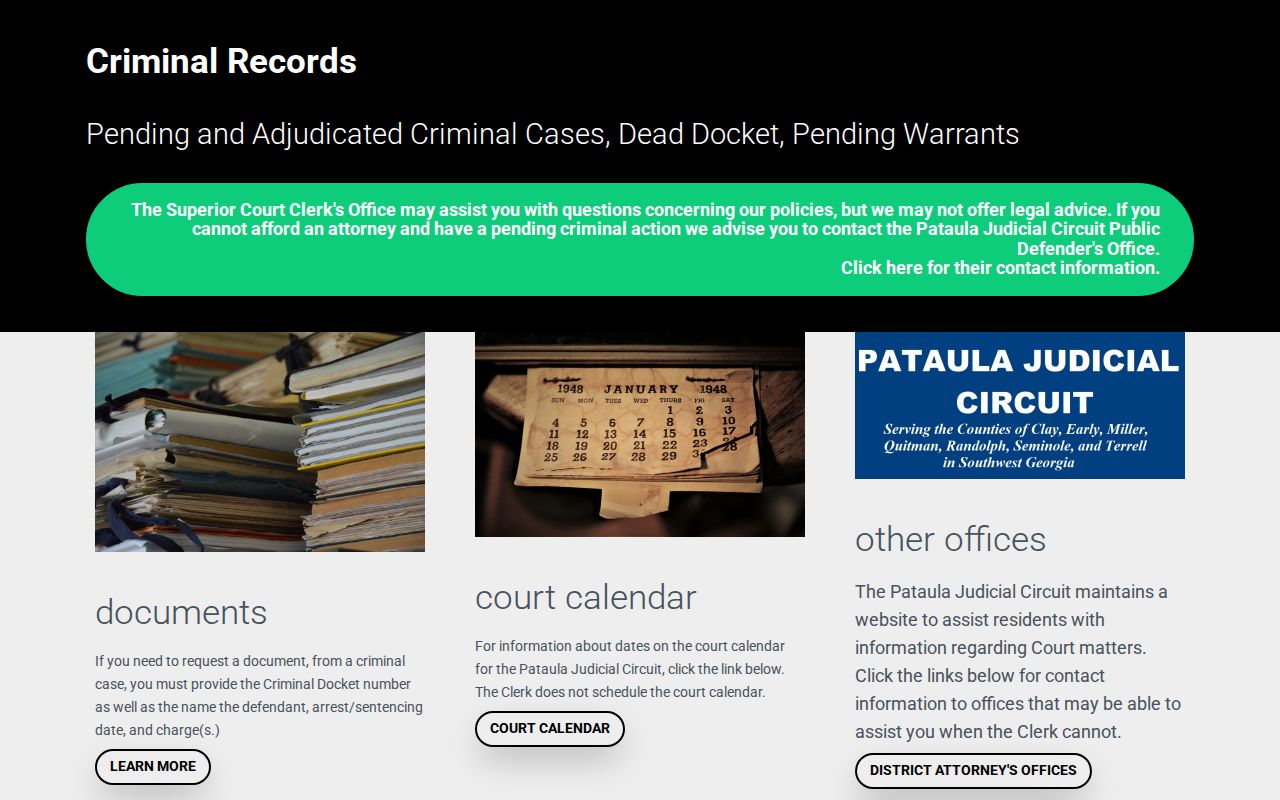
The Clerk keeps the record, while the court controls each setting.
How a Terrell Criminal Case Moves
A Superior criminal docket grows one dated entry at a time. The file may open with an accusation or indictment, pick up counsel and bond events, move through arraignment and pretrial settings, and finally land on a plea or a trial. Orders and sentencing records come after that.
Docket flow: Filing › Arraignment › Pretrial › Plea or Trial › Disposition › Sentencing
Not every case touches every stage, and resets can repeat a setting. When a label is thin, get the signed order or notice rather than inferring a result from the index alone.
Terrell Paper Files Missing Online
PeachCourt does not promise a complete image archive. Its map labels Terrell Superior as e-filed-documents-only. Older paper filings and manual records may need a clerk's help. A missing image does not mean the case is missing. An electronic case should appear but does not. For that, the PeachCourt missing-case form takes an account email, county, court class, case number or URL, and comments. Paper or certified material goes to Tina Ivey's Superior Court Clerk office, and the local criminal request page lays out the direct copy route.
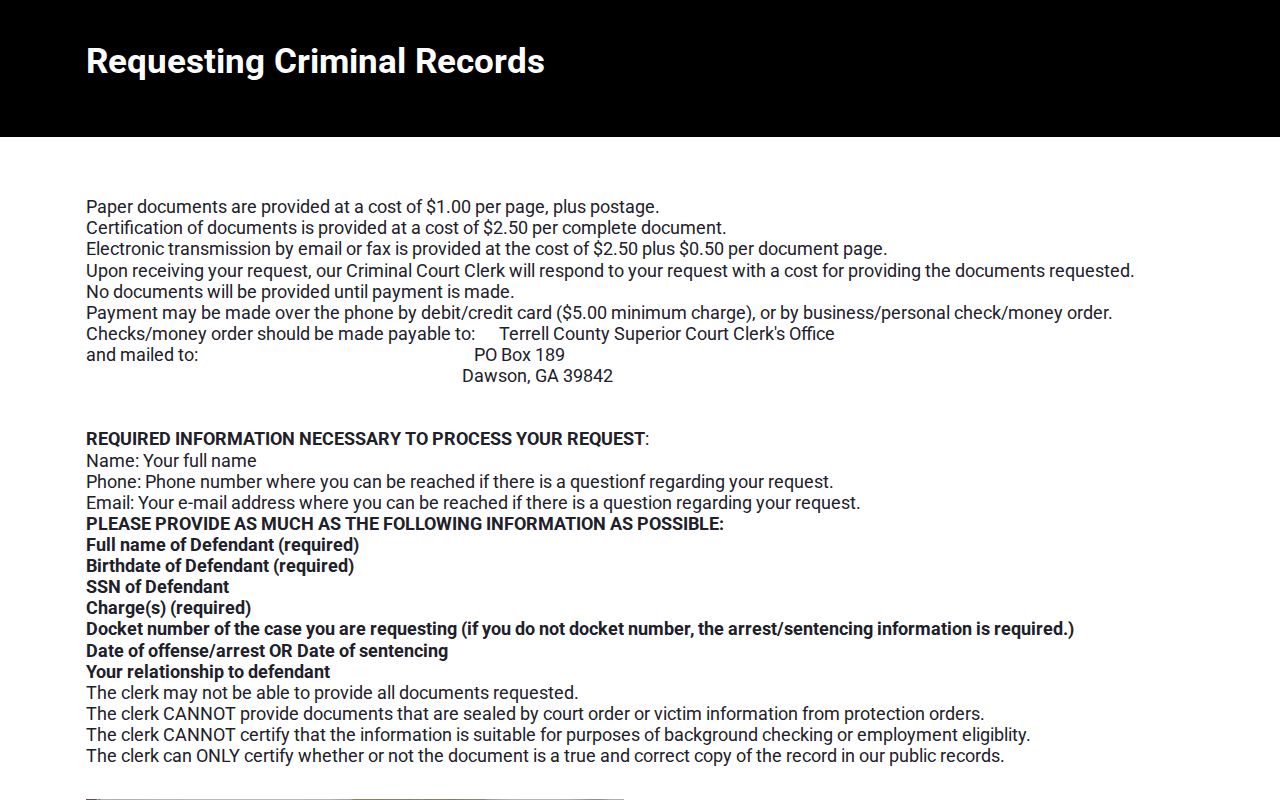
Its fields help staff locate the exact document behind a Terrell criminal docket row.
Courts That Hold Criminal Dockets
Where a record lives depends on court class, and the Georgia court classes define the route. Superior Court handles felonies and general-jurisdiction criminal cases. Magistrate covers warrants and preliminary work. Probate holds county traffic citations, while municipal courts keep city violations and city traffic files.
| Court | Work | Route |
|---|---|---|
| Superior | Felony and Superior criminal | PeachCourt, then Clerk |
| Magistrate | Warrants and preliminaries | Magistrate clerk |
| Probate | County citations | Probate clerk |
| Municipal | City violations | Issuing city |
| Juvenile | Children’s matters | Restricted route |
The official Juvenile Court notice says those records are not public.
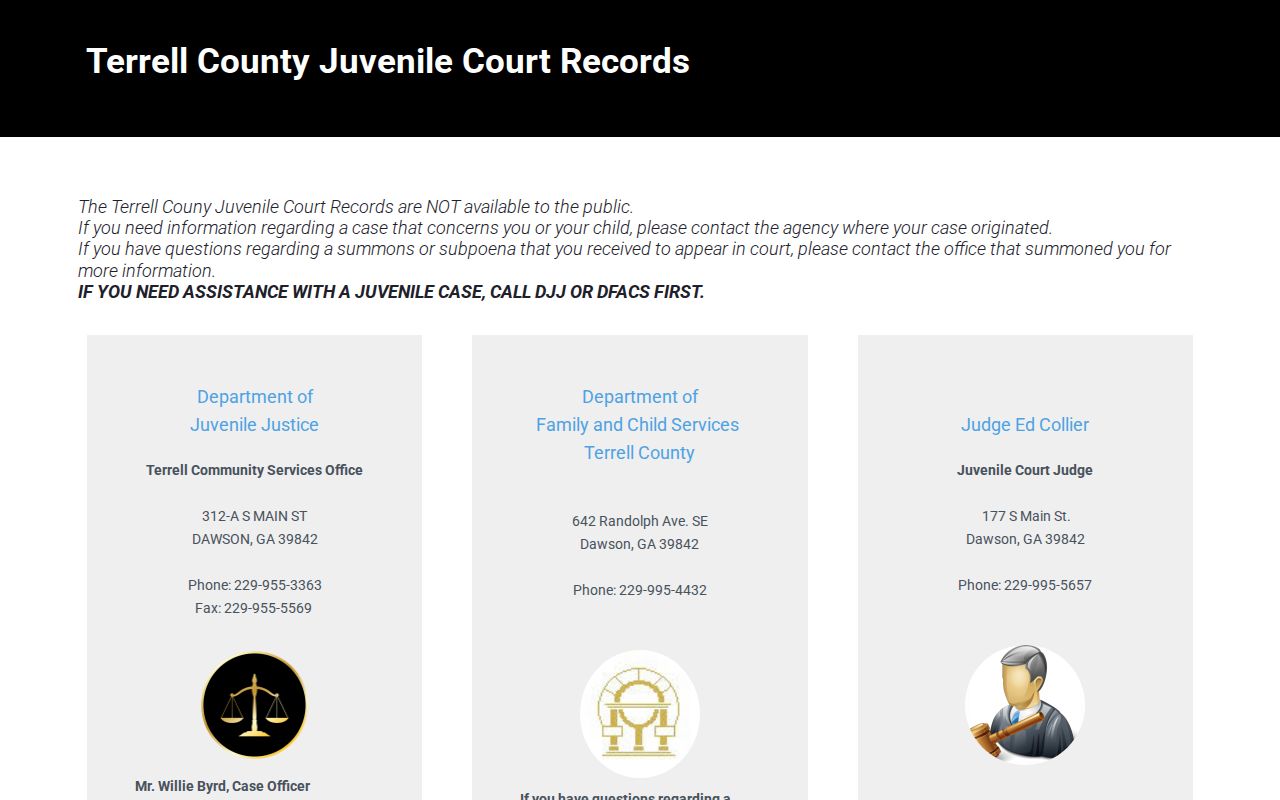
That limit explains why juvenile names do not appear in a normal public search.
Terrell Criminal Counts Differ
For numbers, the Criminal Case Data Exchange dashboard reports disposition transmissions tied to an OTN, short for offense tracking number. County and court filters are available, and the data refreshes every 60 days. It is not a public case-name lookup.
The dashboard counts systems activity; PeachCourt shows events in one case. For Terrell in 2025, AOC's separate Superior series listed 77 felony filings and 30 dispositions, plus 127 misdemeanor filings and 41 dispositions. Treat those self-reported figures as context, not a count of pending cases.
Sealed Dockets and Public Access
Georgia leans toward public access, yet lawful limits still apply. Victim data, protected personal information, juvenile material, and anything covered by a court order may be withheld or redacted. Do not confuse a restricted file with a document that was simply never e-filed.
Key rules:
Uniform Superior Court Rule 21 sets the process for limiting court-record access.
Georgia open-government guidance explains custodians, fees, and redaction.
O.C.G.A. §15-5-112 guidance covers specified judicial home-contact restrictions.
When access fails, ask the Clerk which barrier is in play: an electronic gap, a fee-controlled image, a redaction, or a sealing order. Staff can identify the path, though they cannot give legal advice.
Terrell Copies and Date Checks
A docket result can show a charge yet leave two questions open. What does the signed record say, and when is the next setting? A short row will not answer it. For the first, request the complete plea, order, sentence, or disposition. For the second, use the Pataula calendar. The assigned judge's office can also help. The copy quote depends on page count, delivery, certification, and postage. Certification applies to a whole document, so describe your item by title and event date. Terrell's instructions route schedule questions to the judicial office. The clerk does not set hearings. Keep the source and retrieval date with anything you download. Entries can change after a reset or a later disposition. The court remains the current source.
Choosing the Exact Terrell Record
A docket sheet is not the same as the paper behind one line. The sheet lists what happened and when. Need the full words of an order, plea, or sentence? Ask for that specific item with the Clerk's certification. Requesting the entire file can cost more, so name the piece you want. You might have no docket number. The Clerk can still work with a full name, birth date, charge, and the year the case was likely filed.
Check that you are searching the right Terrell County court. Do not assume the record does not exist. A Superior Court lookup can come back empty. The record may simply sit in Probate, Magistrate, a city court, or a confidential Juvenile Court file. For an entry with no image, write down its date and description. Send those facts with your request. Ask whether the source is electronic or paper. If access is restricted, ask which rule or order controls it. This focused approach helps the Clerk pull the correct Terrell criminal record.
Note: Confirm the current status, the final signed order, copy format, any access limit, and the next hearing setting with the Terrell court that keeps the original criminal docket record.